Talk to Our Engineer, Get a Solution in 20 minutes
Our engineers are the expert in vacuum forming products, you can let them know any requirements and specific demands, then they work out the solution soonest and send back it for free.

Abstract
In thick-sheet vacuum forming, the mold isn’t just a tool — it’s the single biggest lever on cost, quality and speed. plaster, electroplated copper and aluminum molds each solve different problems. this guide explains how they’re made, where they shine, and gives practical decision tools, real-world examples and a short checklist so you can pick the right mold with confidence.
Think of mold selection like choosing shoes: sneakers for prototyping sprints, hiking boots for long rugged trails. the “shoe” you pick for a product determines surface finish, cycle life, maintenance, and ultimately the cost per part. below I explain plaster, electroplated copper and aluminum molds in plain language, show when each is the smart choice, and give hands-on tips you can use in procurement meetings.
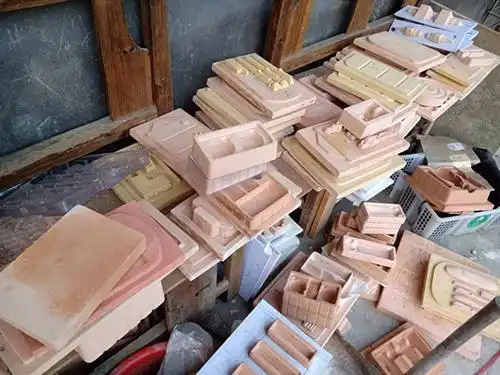
Short description: quick and cheap to make, easy to modify, but short lived.
Why people pick them: you need samples fast, you expect design changes, or you only need a few dozen parts. plaster molds are sculpted or cast, cheap to produce and simple to repair. real-world fit: prototype verification, trade-show pieces, or pre-production samples.
Limitations and gotchas: soft surface, higher roughness, micro-cracking under repeated heat — expect lifetime measured in hundreds (not thousands) of cycles. avoid plaster if you need tight tolerances, glossy surfaces, or long production runs.
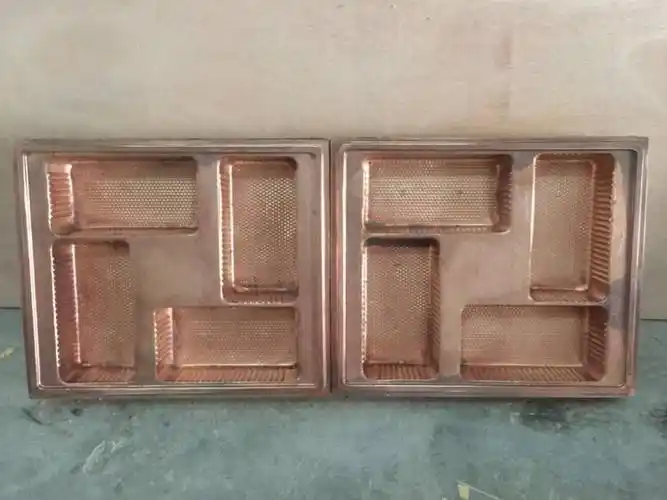
Short description: longer life and better finish than plaster, at moderate cost.
Why people pick them: you want better surface detail and more cycles without the full price of machined metal. you plate copper onto a plaster master to get a harder skin that polishes well and runs thousands to tens of thousands of cycles. real-world fit: appliance housings, mid-volume consumer goods, and medical parts where finish matters but ultra-heavy volume doesn’t.
Limitations and gotchas: base precision depends on the plaster master — so if your prototype was off, the copper won’t fix fundamental geometry errors. copper can be repaired and re-polished, but it won’t match aluminum for thermal control or absolute dimensional stability.
Short description: high upfront cost and lead time, but excellent accuracy, durability and thermal management.
Why people pick them: hundreds of thousands of cycles, tight tolerances, complex assemblies and heat-sensitive materials. aluminum is CNC-machined for repeatability and supports automation and fast cycle times. real-world fit: automotive interiors, aerospace components, and any situation where part-to-part consistency matters.
Limitations and gotchas: higher capital cost and longer lead time. changes are expensive after machining — plan design freezes carefully or use modular inserts for flexibility.
Short description: plaster for tiny runs, copper for medium runs, aluminum for large runs.
Practical thresholds (rule-of-thumb):
• prototype / <1,000 pcs → plaster.
• 1,000–50,000 pcs → electroplated copper often wins.
• >50,000 pcs or continuous production → aluminum usually pays back.
(use these as starting points — your product’s value, scrap cost and tolerance needs can shift the break-even point.)
Short description: high-gloss or sub-mm tolerance → aluminum; decorative / moderate tolerance → copper; rapid iteration → plaster.
Actionable test: if your part must snap into another assembly with ±0.1 mm fit or carry a glossy brand finish, start by assuming aluminum unless cost analysis proves otherwise.
Short description: heat-sensitive polymers benefit from aluminum’s thermal performance.
Practical note: materials like PC or thin-gauge PMMA can deform or craze if cooling is uneven; aluminum’s conductivity reduces warpage and cycle time. for ABS, HIPS and standard PP, copper or plaster can be acceptable depending on part geometry.
Short description: include maintenance, downtime, scrap and lifecycle cost when comparing molds.
What to include in a real quote: mold cost, expected cycles, refurbishment cost (per N cycles), average cycle time, scrap rate, operator time for rework, and expected downtime for maintenance. shorter time-to-market can justify higher mold cost (faster aluminum cycles reduce per-part labour).
Short description: match mold type to product lifecycle and industry demands.
Examples:
• short-term promotional displays — plaster or copper.
• home appliance housings — copper for most parts; aluminum for key structural components.
• automotive interiors — aluminum for safety-critical and cosmetic parts.
• medical device housings (small runs but high spec) — copper can be used; aluminum if sterilization or precision is required.
Short description: hybrid approaches and digital simulation reduce risk and cost.
what’s changing: 3d-printed masters speed iteration; resin-composite molds and aluminum-copper hybrid structures balance cost and performance; cae thermoforming simulation helps predict forming defects before you cut metal.
Practical checklist: how to pick the mold in a single meeting
Hypothetical payback thought experiment (illustrative only)
Assume: plaster mold cost = low, copper = moderate, aluminum = high. if aluminum is 10× the cost of copper but reduces scrap and cycle time sufficiently, it may pay back at large volumes. this is only illustrative — run your own numbers: total cost = mold amortization + production cost per part (labour, cycle time, scrap) over expected production.
Questions to ask your mold maker (short list)
• what is the expected cycle life under our material and cycle time?
• can the mold be repaired or reworked? what is the cost?
• what lead time and milestones do you offer (prototype approval, first article)?
• can you provide a surface finish sample or polish standard?
• are modular inserts possible for late-stage changes?
Tips for mold care and maintenance (practical, not theory)
• schedule regular inspections after the first 500 and 2,000 cycles.
• track part dimensions with SPC during initial production runs.
• keep a log of thermal cycling; sudden spikes often precede cracking.
• for copper molds, re-polish proactively — small scratches grow into problems.
There’s no single “best” mold — only the best mold for your product, quantity, budget and timeline. plaster gives speed and flexibility for prototypes; electroplated copper is the pragmatic choice for many mid-volume products; aluminum is the durable backbone for high-volume, high-precision manufacturing. use the checklist above, run the simple payback numbers, and involve your mold maker early — that combination cuts surprises and speeds time-to-quality.
Q: how long does it take to make each mold type?
A: plaster: days to a week; copper (with plating): 1–3 weeks; aluminum cnc: several weeks to months depending on complexity. (times vary by shop and complexity.)
Q: can i start with plaster and move to aluminum later?
A: yes — that’s a common path: plaster for iteration, then copper or aluminum for production. plan for dimensional alignment when switching materials.
Q: will electroplated copper ever match aluminum for finish?
A: copper can be polished to high quality and is excellent for many decorative parts, but aluminum provides better dimensional stability and thermal control.
Q: are there hybrid mold options?
A: yes — composite cores, aluminum bases with copper or plated inserts, or 3d-printed master patterns combined with plating are all viable hybrid approaches.
Q: what’s the single most common mistake companies make?
A: choosing a mold solely on lowest upfront price without factoring scrap costs, rework time, and lifetime — that usually backfires.
Foshan Tekaopu Plastic Technology Co., Ltd. supports end-to-end solutions for thick-sheet vacuum forming. they help customers evaluate trade-offs, prototype on low-cost molds, and scale to production with copper or aluminum tooling depending on needs.

TKP Plastic is China's leading provider of vacuum forming solutions. We are defined by our commitment to innovation, uncompromising quality, and total customer satisfaction. Our expertise enables us to deliver projects that excel in cost-effectiveness, intricate design, and sustainable manufacturing. Partner with TKP to bring your vision to life with precision and reliability.