Talk to Our Engineer, Get a Solution in 20 minutes
Our engineers are the expert in vacuum forming products, you can let them know any requirements and specific demands, then they work out the solution soonest and send back it for free.

An accessible, practical guide to heavy-gauge thermoforming — when to pick it, how to design for it, and how to avoid the usual traps.
Why this matters and what you can actually use from this guide.
Think of heavy-gauge thermoforming as the “fast, large, and flexible” option in your manufacturing toolkit. It’s great when parts are big, molds need to be cheap, or you want to iterate quickly. But the details — material choice, draft angles, finish, and certification — are the places projects either win or stall. This guide gives simple rules you can use at the drawing board, in RFQs, or in product pages.
What thermoforming is and when it beats other methods.
Heavy-gauge thermoforming heats a thick plastic sheet and shapes it over a mold with vacuum and/or pressure. Compared with injection molding you get lower tooling cost and faster iteration; compared with metal or composites you get lighter parts and faster changeovers. Use it when part size, surface area, or quick tooling matters more than tiny part-to-part tolerances at millions of units.
Which polymers do what — pick for function, not for brand names.
Common choices and why you’d pick them:
Regulated buyers want paperwork; retail buyers want looks.
Automotive, appliances, medical, and food sectors are big users. If you sell into food or medical markets, buyers expect material certificates and traceability. If you sell to retail, surface finish and color consistency are king. Factor documentation and inspection into timelines and costs.
Large shells, continuous curves, and shallow draws are easy; deep undercuts are not.
Thermoforming loves broad, continuous curves and shallow draws. Tight internal corners, deep draws, and intricate undercuts are expensive or impossible without special tactics (pressure forming, split molds, or assembling multiple pieces). Always use generous radii and draft angles and plan ribs for stiffness.
Quick, plain examples to show why thermoforming was chosen.
Texture and printing are inexpensive; vacuum metallization and multi-bond assemblies cost more.
Low-cost: surface textures, pad printing, simple dyes. Medium-cost: film lamination and flame treatment for paint. High-cost: metallization, multi-material bonding, or thick plated finishes. Tip: hide tooling marks with texture rather than polishing every surface.
Tooling is cheap and fast; per-part costs can be high for small runs depending on finishing.
Thermoforming tools are lower cost and easy to iterate (often wood or soft metal). But if you need heavy finishing or expensive materials, per-part cost rises. Injection molding usually becomes cheaper only after very large volumes or when very fine features are required.
Design for one material, use recyclable grades, and minimize bonded assemblies.
Single-material parts are easier to recycle. Specify recyclable grades (PET, PP, PE) when possible. Avoid permanent multi-material bonds that kill recycling. Also ask your supplier about returning clean scrap for regrind.
The tests and documents you should demand before accepting parts.
Require: wall-thickness maps, a dimensional report for critical interfaces, surface inspections, and for regulated parts — material certificates and third-party test reports. Put acceptance criteria into the PO so there’s no argument later.
Plain language that builds trust: problems, proof, and paperwork.
Lead with the buyer’s problem: “Large seamless housings without costly metal tooling.” Provide three proofs: material certificates, a short case study with photos, and expected lead times. Offer downloads: datasheets and FAI (first article inspection) reports.
| material | typical thickness (mm) | typical use |
|---|---|---|
| ABS | 2.5–6.0 | painted housings, durable covers |
| PC | 2.0–6.0 | clear guards, protective shields |
| PET / PETG | 1.5–6.0 | food trays, clear enclosures |
| PP / PE | 2.0–8.0 | chemical-resistant trays, liners |
| PMMA | 2.0–6.0 | signage, light diffusers |
| PS / HIPS | 1.5–6.0 | POS displays, low-cost panels |
(Use these as starting points — always prototype to confirm final wall thickness and draw limits.)
1.What is vacuum forming?
Large structural parts are formed using a heated, thick plastic sheet through vacuum/pressure molding.
2.What materials are commonly used?
ABS, PC, PET/PETG, PP/PE, PMMA, PS/HIPS, PVC.
3.How to choose materials?
Primarily consider temperature resistance, impact resistance, transparency, chemical resistance, and compliance. Single-material formulations are preferred.
4.Which industries commonly use vacuum forming?
Automotive, home appliances, medical, food, display and advertising, industrial equipment.
5.What products is it suitable for?
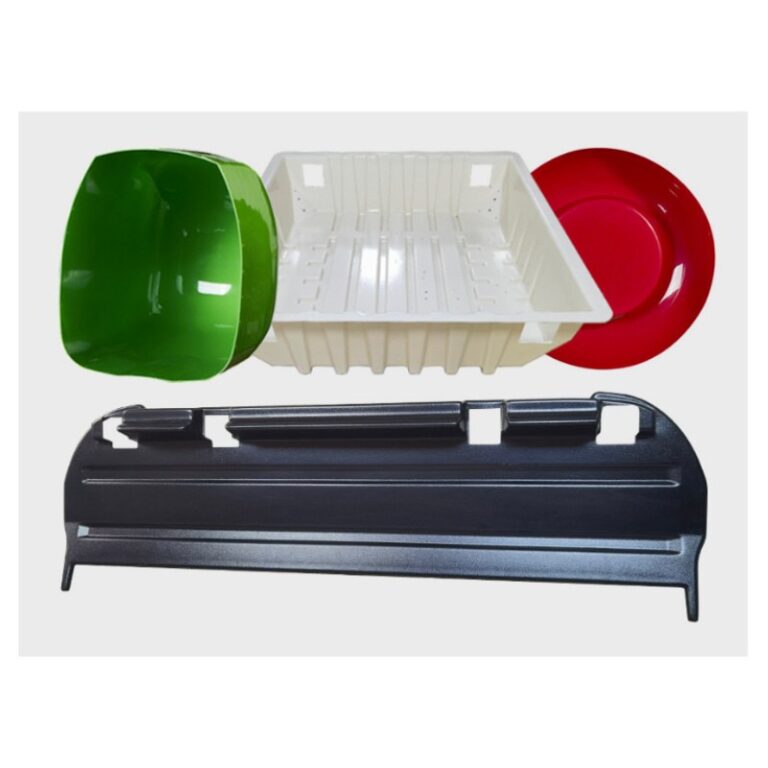
Lane linings, shells, trays, display racks, chassis, billboards, and other large or medium-volume parts.
6.What are the advantages compared to injection molding?
Lower mold costs, faster iteration, suitable for large and small-to-medium batch production; however, the material/labor costs per piece are higher.
7.What are some common surface/post-treatment processes?
Texture, spraying, printing, lamination, heat treatment, vacuum electroplating (increasing cost).
8.What are the key factors affecting cost and delivery time?
Mold material, surface treatment, material unit price, and batch size.

TKP Plastic is China's leading provider of vacuum forming solutions. We are defined by our commitment to innovation, uncompromising quality, and total customer satisfaction. Our expertise enables us to deliver projects that excel in cost-effectiveness, intricate design, and sustainable manufacturing. Partner with TKP to bring your vision to life with precision and reliability.