Talk to Our Engineer, Get a Solution in 20 minutes
Our engineers are the expert in vacuum forming products, you can let them know any requirements and specific demands, then they work out the solution soonest and send back it for free.

Most people ask this question the wrong way.
They ask it like there’s a single “vacuum forming plastic” — as if you can just pick one, heat it up, and everything magically works.
That’s not how vacuum forming behaves in real life.
The truth is simpler and more uncomfortable:
The plastic chooses the process just as much as the process chooses the plastic.
If you’ve ever watched a sheet sag beautifully… then tear at the corners, wrinkle at the base, or come out cloudy and weak — you already know what I mean.
This article explains which plastics are actually used, why they behave the way they do, and how people who do this for a living decide — not how catalogs describe it.
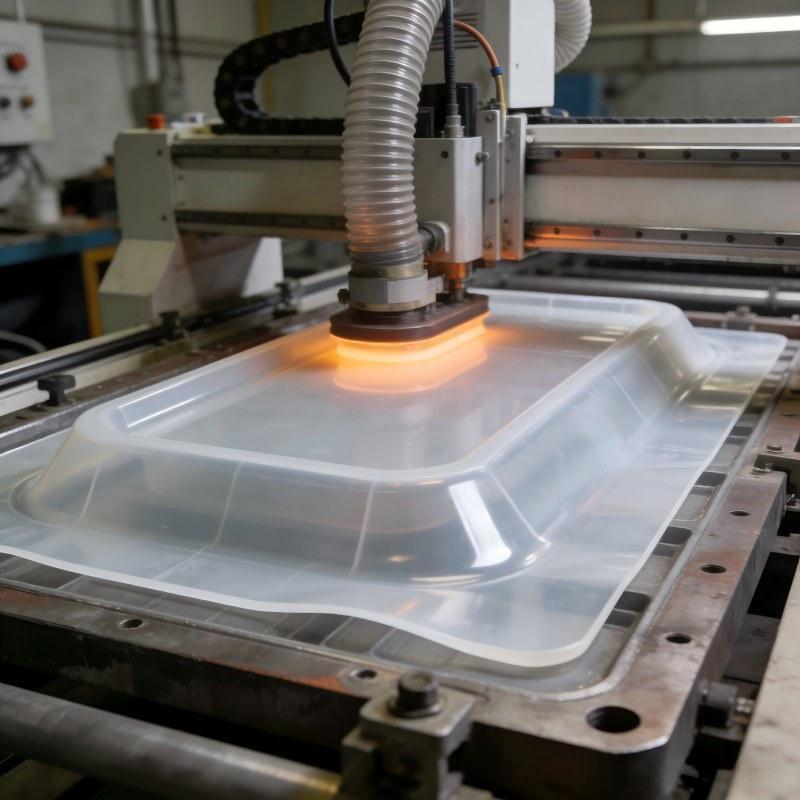
Vacuum forming only works with thermoplastics.
Not because the industry says so — but because physics does.
Thermoplastics soften when heated and become solid again when cooled. No chemical reaction. No curing. No irreversible change.
That means:
Thermosets don’t do this. Once they cure, they’re done.
So every plastic used in vacuum forming lives in the thermoplastic family — but not all thermoplastics behave kindly when you try to form them.
That’s where things get interesting.
Forget brand names for a moment.
The most important split is amorphous vs semi-crystalline plastics.
This one decision determines:
These soften gradually over a temperature range.
They don’t suddenly collapse or crystallize. They give you time. They forgive mistakes.
That’s why most vacuum forming shops default to amorphous plastics, especially for complex shapes or thick sheets.
Examples you’ll see constantly:
These behave differently.
They stay stiff… then suddenly lose structure… and if you miss the window, you’re done.
They’re used when you need their properties — not because they’re fun to form.
Examples:
If you’re new to vacuum forming and struggling, it’s often because you chose a semi-crystalline plastic without realizing what you signed up for.
If vacuum forming had a “default answer,” this would be it.
ABS is used everywhere — not because it’s perfect, but because it’s predictable.
Why professionals like ABS:
ABS doesn’t look fancy. It doesn’t chase optical clarity. It just works.
That’s why you’ll find it in:
If someone says, “I just need this to form cleanly and survive real use,” ABS is usually where the conversation starts.
High-Impact Polystyrene is the reason so many prototypes exist.
It forms easily. It heats quickly. It’s inexpensive.
And it tells the truth:
But for:
HIPS is brilliant.
It lets designers test shapes fast without burning money — which is why vacuum forming exploded in prototyping once HIPS became common.
People love clear parts.
They just don’t love how brittle acrylic can be.
That’s where PETG earned its place.
PETG gives you:
It doesn’t yellow like cheap plastics. It doesn’t craze as easily. And it behaves well even at thinner gauges.
That’s why PETG shows up in:
If clarity matters and the part needs to survive handling, PETG is often the quiet winner.
Acrylic looks incredible.
No argument there.
Its clarity is glass-like. Its UV resistance is excellent. Its surface finish sells products.
But it doesn’t forgive bad design.
Sharp corners? It cracks.
Uneven heating? It crazes.
Overstretch? It fractures.
Professionals choose acrylic when appearance matters more than toughness — and when the mold design is dialed in.
Acrylic rewards precision. It punishes shortcuts.

If you’ve ever tried forming polycarbonate, you know:
This plastic demands respect.
It’s tough. Extremely impact resistant. Used when safety matters.
But:
You don’t choose polycarbonate casually. You choose it because the part must survive impact, abuse, or safety testing.
That’s why it’s used in:
Yes, they are used. No, they are not beginner-friendly.
They’re chosen for:
But they shrink more. They warp easier. And their forming window is narrow.
Most shops only use them when their properties are mandatory, not because they enjoy working with them.
Here it is — the quiet killer:
Choosing plastic by name instead of by behavior.
People say: “I want PETG.” “I want ABS.” “I want PP.”
The better question is:
Once you answer those, the plastic becomes obvious.
The honest answer:
Whichever thermoplastic best matches the part’s real job — not the spec sheet fantasy.
Most of the time, that means:
Vacuum forming isn’t about memorizing materials.
It’s about understanding how hot plastic wants to move — and choosing one that moves the way your design needs it to. Contact TPK Vacuum Forming for profession advice for your project.

TKP Plastic is China's leading provider of vacuum forming solutions. We are defined by our commitment to innovation, uncompromising quality, and total customer satisfaction. Our expertise enables us to deliver projects that excel in cost-effectiveness, intricate design, and sustainable manufacturing. Partner with TKP to bring your vision to life with precision and reliability.