Contents
- Introduction — why this comparison matters (and why you should read on)
- What is injection molding? (human + technical)
- How injection molding works — the choices that shape cost and quality
- What is plastic thermoforming? (human + technical)
- How thermoforming works — the levers that designers rarely talk about
- Key differences — an engineer’s checklist (cost, size, tolerances, lead time, sustainability)
- Advantages & disadvantages — but with real-life trade-offs and when to accept them
- Two short case studies — practical comparisons you can relate to
- Advanced DfM tips — what your supplier wishes you knew
- Sustainability & lifecycle thinking — beyond “recyclable” stickers
- Quick decision checklist you can print and use now
- Conclusion & recommendation
- FAQ — concise answers to the questions that actually come up
1. Introduction — why this comparison matters (and why you should read on)
When a product idea becomes real, the choices you make about how to make its parts change its cost, reliability, time to market, and even the brand story. “Injection molding” and “thermoforming” can sound like two options on a spec sheet, but they are different philosophies: one optimizes for precision and scale; the other for size and speed. This article will humanize those technical trade-offs — showing you not only what differs but why it matters, how to decide using simple arithmetic, and how to avoid the mistakes that cost time and margins.
2. What is injection molding? (human + technical)
Injection molding is the industrial equivalent of casting a complex shape from molten plastic inside a hard, precisely machined cavity. Imagine forcing syrup into a steel cookie cutter under pressure, cooling it fast, then popping out a finished piece — at scale and with very tight repeatability.
Why teams love it:
- Extremely repeatable parts with fine detail (clips, threads, snap-fits, thin walls).
- Excellent cosmetic finishes (gloss, matte textures, micro-textures).
- Economies of scale: high tooling cost, low unit cost as volumes grow.
Why it sometimes causes friction:
- The mold is a piece of capital equipment — time-consuming to design, machine, test, and maintain.
- Iterations are expensive; design changes after tooling are painful.
3. How injection molding works — the choices that shape cost and quality
Important decision points that are often glossed over:
- Material choice & conditioning — hygroscopic nylons need drying; filled resins change flow.
- Gate type and location — affects aesthetic, filling, and internal stresses.
- Runner system — hot runners reduce scrap but add tooling cost and complexity.
- Cooling strategy — the fastest cycle is not the best if warpage rises; cooling lines are the mold’s heartbeat.
- Venting and degassing — trapped air ruins parts; vents are tiny but essential.
- Ejection & part handling — robot vs. manual: automation changes cycle time and defect rates.
Designing for injection molding is a systems conversation — geometry, material, tool, and automation must align.
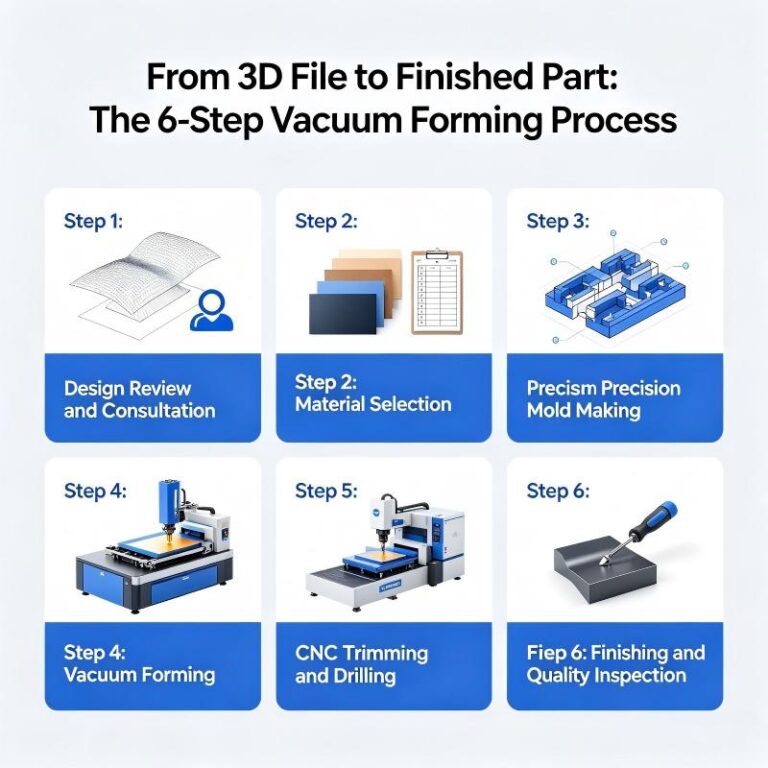
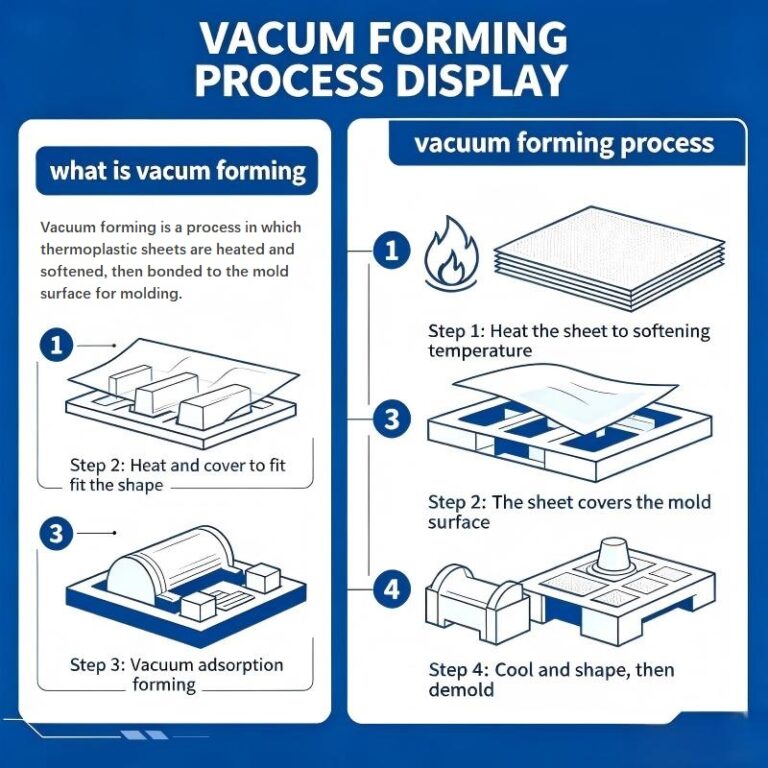
Thermoforming heats a plastic sheet until it sags like warm wax, then shapes it over a mold with vacuum and/or pressure. Picture wrapping cling film tightly over a shaped bowl and then cutting away the excess.
Why teams choose it:
- Low-cost molds and fast tooling make early production and large panels affordable.
- Large single-piece parts (appliance fascias, trays, housings) can be made without giant injection tools.
- Quick iterations: change the mold, not the entire factory.
Limitations to accept:
- Thinner areas where the sheet stretches (expect variable wall thickness).
- Less fine detail than injection molded parts unless pressure forming and tight process control are used.
Practical levers that influence feasibility and quality:
- Sheet thickness & gauge selection — determines final stiffness and shrinkage behavior.
- Heating profile — center vs. edge temperatures change stretch and thinning.
- Plug assist — a shaped plug pre-stretches the sheet to control thinning in deep draws.
- Pressure forming vs. vacuum forming — pressure forming gives better detail and thinner corners.
- Trim strategy — how you nest and trim affects material yield and scrap rate.
- Twin-sheet forming — creates hollow or structurally reinforced parts but requires precise timing and clamping.
Thermoforming can be deceptively simple to prototype and surprisingly demanding to optimize for low scrap and consistent cosmetics.
6. Key differences — an engineer’s checklist
Here are the dimensions that actually influence decisions in product teams:
- Tooling cost & lead time
- Injection: high cost (steel molds), weeks to months.
- Thermoforming: lower cost (aluminum/composite), days to weeks.
- Unit cost
- Injection: low at high volumes.
- Thermoforming: higher per part, but favorable for large sized parts or low volumes.
- Part size
- Injection: limited by mold and press size.
- Thermoforming: excellent for very large parts (vehicle panels, large trays).
- Design complexity
- Injection: internal features, thin ribs, threads are possible.
- Thermoforming: best for relatively simple, single-wall geometry (add ribs/embossing to stiffen).
- Tolerances
- Injection: ±0.05–0.2 mm (depending on size and material).
- Thermoforming: typically looser, in the ±0.5 mm or more range for many dimensions.
- Surface detail
- Injection: microtextures and gloss/matte control.
- Thermoforming: textures from mold possible, but feature fidelity is less.
- Sustainability
- Injection: less trimming waste, but molds and energy per cycle matter.
- Thermoforming: trimming waste can be significant but scrap can be collected and reground into sheet in some cases.
7. Advantages & disadvantages — with the practical trade-offs
Injection molding — advantages
- Predictable dimensions and tight tolerances.
- Low unit cost at scale and repeatable mechanical properties.
- Can integrate functional features (threaded bosses, snaps, overmolding).
Injection molding — disadvantages
- High tooling cost and long lead time to first part.
- Iterations are costly; design-for-change is hard.
- Not cost-effective for very large single-piece panels.
When to accept injection’s trade-offs: your product relies on precision fits, integrated mechanical features, or you’re targeting volumes in the tens of thousands per year.
- Quick & inexpensive tooling; excellent for prototypes and short runs.
- Cost-effective for large, single-walled parts.
- Easier to change tooling and iterate on geometry.
- Less geometric detail and looser tolerances.
- Thinning in stretched regions can cause functional issues if not designed carefully.
- Trim waste requires planning for recycling or material cost.
When to accept thermoforming’s trade-offs: when size, lead time, and lower upfront spend are critical — e.g., medical tray runs of a few thousand, packaging, appliance fascias.
8. Two short case studies — practical comparisons you can relate to
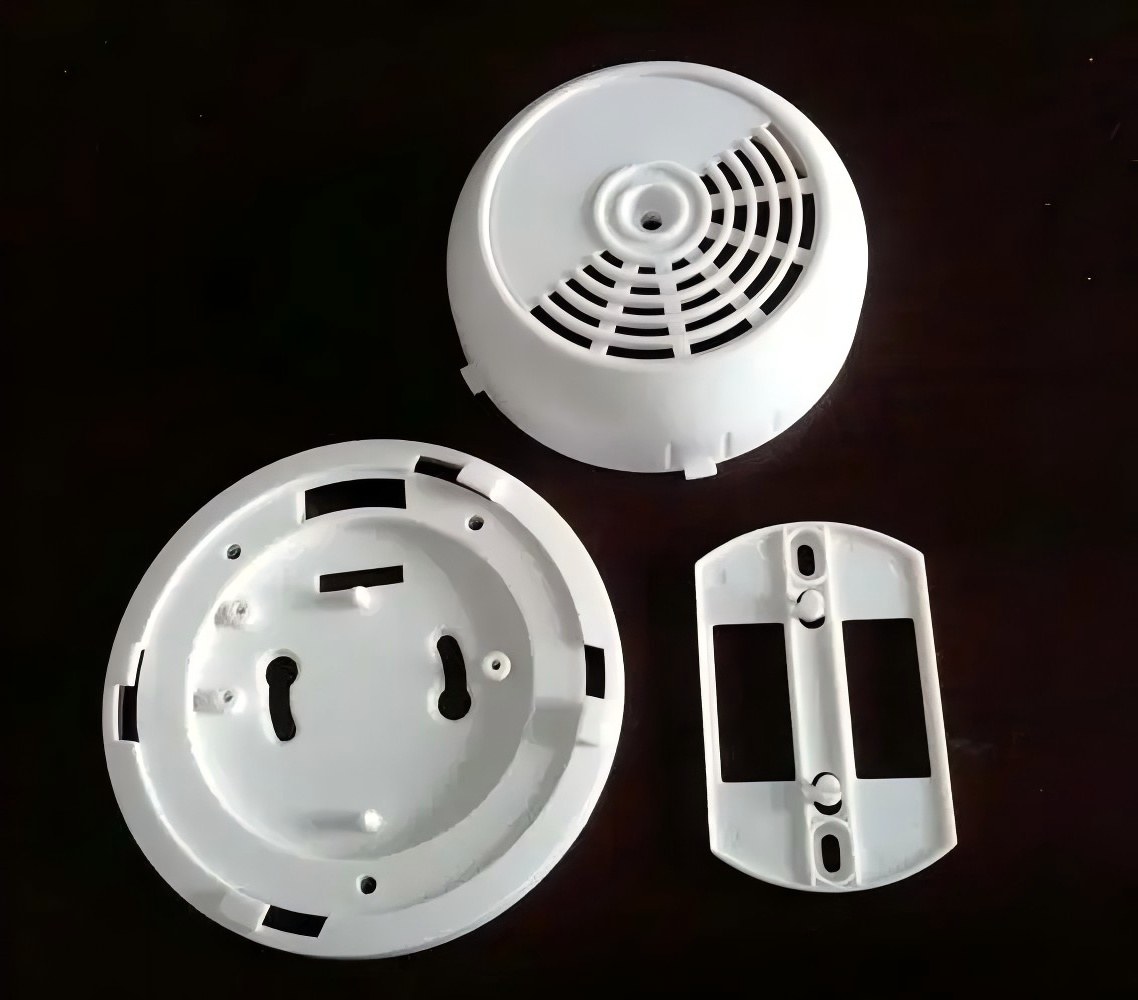
Case A — A consumer electronic housing (small, complex, snap-fit features)
- Requirements: thin walls (1 mm), integrated clip features, precise mounting bosses, 200,000 units/year.
- Best fit: Injection molding. The upfront tooling and tighter tolerances pay off in the long run. Thermoforming cannot produce reliable thin bosses and fine snaps with predictable dimensions.
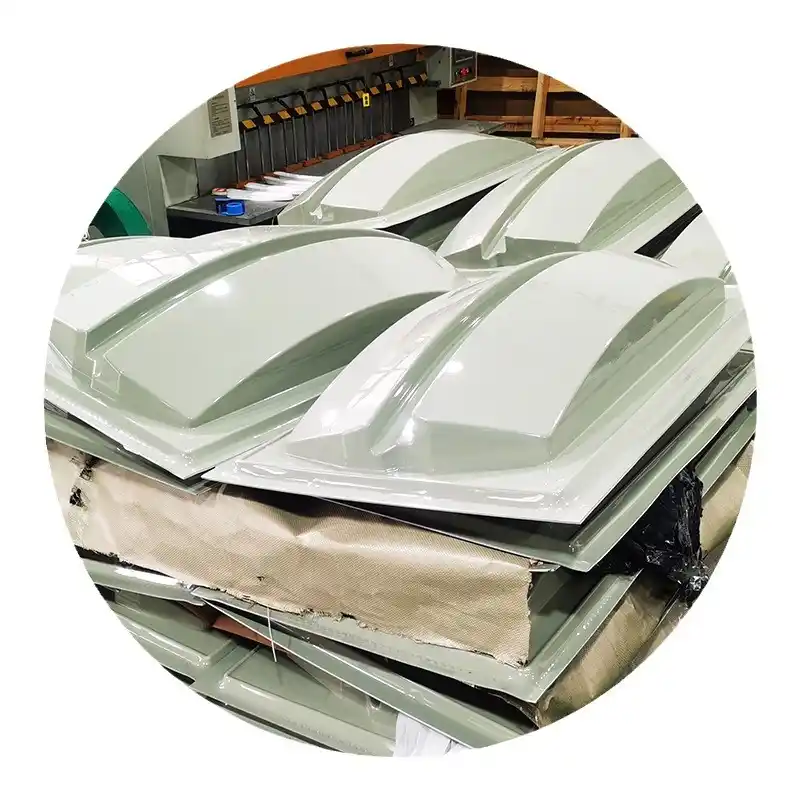
Case B — A large retail display or appliance front panel (1,000 × 600 mm)
- Requirements: large single piece, low-to-medium volume (5,000–20,000 units), good cosmetic finish, short time-to-market.
- Best fit: Thermoforming (pressure forming). Tooling is quicker and cheaper; material handling and finishing are simpler than trying to assemble many injection pieces into a large panel.
9. Advanced Design-for-Manufacturing (DfM) tips — what your supplier wishes you knew
Small changes early save thousands later. A few high-leverage tips:
For injection molding
- Design constant wall thickness where possible — variable thickness causes sink marks and warpage.
- Add ribs instead of thickening walls for stiffness (but keep rib thickness ≤60% of wall thickness).
- Draft angles: vertical faces need draft; lack of draft damages part and mold.
- Align features with melt flow to avoid weld lines in critical areas.
- Consider family molds (multiple cavity types in the same tool) only if volumes justify complexity.
For thermoforming
- Use beads and embossed ribs to increase stiffness without thicker material.
- Avoid sharp internal corners — they thin badly when stretched.
- Draft and radius are still useful — parts release easier and trim is cleaner.
- Nest parts to minimize scrap and plan for reclaim/regrind lines if feasible.
- For deep draws, use plug assist and multi-stage heating to even out thickness distribution.
10. Sustainability & lifecycle thinking — beyond “recyclable” stickers
A green choice is nuanced:
- Material selection matters more than process. PET/G and certain recycled/biobased resins can be used in both processes, but availability in sheet vs pellet forms restricts options.
- Scrap logistics: thermoforming generates trim scrap; can it be collected and reground locally? If not, the environmental cost increases. Injection molding’s runner and sprue waste is often closed-loop at the molder.
- Energy per part: injection presses use a lot of power per cycle, but unit energy can be lower at high volumes. Thermoforming’s oven energy per large part can be efficient, but repeated heating of large sheets stacks up.
- Lifespan & repairability: a thicker thermoformed shell might be easier to repair; injection parts with complex overmolding can be harder to separate for recycling.
- Design for disassembly: if you combine thermoformed shells with injection molded inserts, design fasteners for disassembly and material separation.
Ask suppliers for a simple cradle-to-gate estimate — it’s often decisive for sustainable product lines.
11. Quick decision checklist (printable)
- Does the part require integrated, high-precision features (threads, bosses, snaps)? → Injection
- Is the part physically large (bigger than the typical injection press platens)? → Thermoforming
- Is the expected run < 10k and you need a fast market entry? → Thermoforming
- Are you targeting > 50k units and need low unit cost? → Injection
- Is trim scrap acceptable or can it be recycled economically? → Thermoforming (if yes)
- Will frequent design iterations be needed? → Thermoforming (faster iteration cycle)
- Are there special material requirements only available in pellet form (e.g., certain flame-retardant grades)? → Injection
12. Conclusion & recommendation
Neither process is strictly “better.” They solve different sets of constraints. The best engineering answer emerges when you:
- quantify volumes and timelines;
- list the must-have functional features;
- run a break-even calculation with realistic quotes;
- include secondary operations and sustainability choices; and
- prototype early to expose real-world issues.
If you want a fast recommendation: for small, detail-rich parts at scale pick injection molding; for large, fast-to-market panels and low-to-mid volumes pick thermoforming. For many products, the optimal solution is hybrid — use each technique where it’s strongest.
13. FAQ — concise answers to the questions that actually come up
Q: Can thermoforming replace injection molding completely?
A: No — each has structural and precision strengths. Thermoforming can substitute for injection in some simple parts, but it cannot produce integrated thin bosses or fine snap-fits reliably.
Q: Can I combine them?
A: Yes. A common approach is a thermoformed shell for the outer cosmetic piece and injection molded inserts for structural or precision features.
Q: How do I estimate lead times?
A: Thermoforming molds can be ready in days–weeks. Injection molds in weeks–months depending on complexity and steel grade.
Q: Will a cheaper thermoforming tool always save money?
A: Not necessarily. High scrap, secondary assembly, or low part performance can erase upfront savings. Always compare total cost of ownership.
Q: What about prototyping?
A: 3D printing is excellent for form-check and low-strength prototypes. For functional prototypes that mimic production behavior, you can use short-run aluminum/injection molds or CNC’d thermoforming molds.