Talk to Our Engineer, Get a Solution in 20 minutes
Our engineers are the expert in vacuum forming products, you can let them know any requirements and specific demands, then they work out the solution soonest and send back it for free.
So you’ve decided to source your vacuum forming (thermoforming) parts from overseas — and more likely than not, from China, the world’s largest plastics manufacturing hub.
That decision opens up cost advantages and access to advanced manufacturing capabilities. But it also introduces a complex web of cross-border compliance requirements that many procurement professionals underestimate.
I’ve watched too many purchasing managers get lured in by a sharp quote, place an order, and then find their shipment held at customs for two weeks, hit with unexpected tariffs, or — in the worst cases — rejected outright due to non-compliant materials.
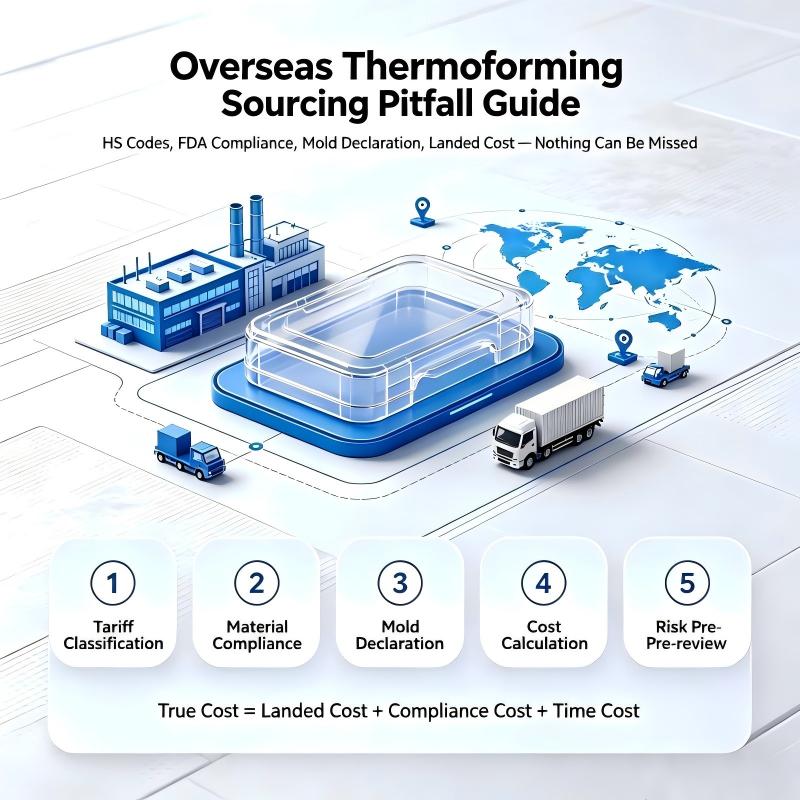
Here’s the truth that separates savvy buyers from the rest: The real cost of procurement isn’t the factory price. It’s your total landed cost + compliance cost + time cost.
Below are five traps we’ve seen overseas clients fall into repeatedly over our 15 years of exporting to 50+ countries. Behind each trap lies a clear, preventable solution.
Your HS Code (Harmonized System Code) is your product’s “identity card” to customs authorities around the world. Classify your plastic parts under the wrong code, and you could face wildly different tariff rates — or even find that you need an import license you don’t have.
Many buyers simply lump all “plastic products” under Chapter 39. But in practice:
Pro Tip: The HS code on your supplier’s export document and the code you declare on import must be logically consistent. If they don’t match, customs data cross-checks can trigger red flags.
The end-use of your thermoformed parts determines which compliance standards apply:
Buyers negotiate price and delivery, but fail to specify in the contract that the supplier must provide compliance certificates. Then, when the goods arrive at port, they discover the supplier cannot produce third-party lab test reports (e.g., FDA compliance documents).
An even more subtle pitfall: the material changes, but the certificate doesn’t. To cut costs, the supplier switches to a different resin brand during mass production — but still sends you the compliance file from the prototyping phase. Customs takes a sample, finds a mismatch, and holds the entire shipment.
Pro Tip: Don’t just accept a “certificate scan” from your supplier. Request batch-specific test reports, because compliance means “every batch passes,” not “certified once, valid forever.”
When you pay a Chinese factory to develop molds for your thermoformed parts, customs authorities in many countries consider that tooling cost part of the product’s value. If you don’t declare it, customs may treat it as deliberate undervaluation.
U.S. Customs valuation rules explicitly state: The value of “Assists” — molds, tools, designs, etc. provided by the importer — must be added to the dutiable value of imported merchandise. If you pay the mold fee domestically but don’t reflect it in your customs declaration, a customs audit could result in:
Country of Origin (COO) isn’t just about printing “Made in China” on the packaging. If your product is manufactured in China but transshipped or repackaged in a third country, how origin is determined affects the applicable tariff rate.
A complete export clearance document package includes at least:
Pro Tip: Have your supplier send you draft documents before shipment — and have your customs broker review them. Do not wait until the goods have already arrived at port to start preparing paperwork.
This is the most expensive trap of them all. You think you saved 10% on the purchase price, but end up paying 20% more in tariffs, logistics, clearance, and warehousing.
One client chose the absolute lowest-quote supplier — but that supplier was located inland, requiring a three-day truck haul to port, and had no in-house customs clearance team. The result:
Final total cost ended up 15% higher than if they had chosen the slightly higher-quoted but experienced supplier.
During the RFQ (Request for Quotation) phase, ask your supplier to provide:
Each of the five traps above — misclassified HS codes, missing compliance certifications, undeclared tooling, incomplete documentation, and failing to calculate full landed cost — points back to one core capability:
Does your supplier truly understand international trade, or are they just a production shop?
If you work with a factory that only knows how to mold plastic but doesn’t understand export compliance, you become responsible for all the regulatory risk. But if your supplier has 15 years of export experience, knows the clearance requirements of 50+ countries — like we do at TKP — they’ll proactively guide you past these pitfalls.
Smart procurement isn’t about “buying cheap.” It’s about using a proven, disciplined process to get a predictable, reliable outcome.
What compliance challenges have you faced when importing plastic parts? Share your experience in the comments below. In our next post, we’ll dive into material selection for thermoforming — ABS vs. PETG vs. PC, when to choose which, and how the cost differences really play out in production.

TKP Plastic is China's leading provider of vacuum forming solutions. We are defined by our commitment to innovation, uncompromising quality, and total customer satisfaction. Our expertise enables us to deliver projects that excel in cost-effectiveness, intricate design, and sustainable manufacturing. Partner with TKP to bring your vision to life with precision and reliability.