Talk to Our Engineer, Get a Solution in 20 minutes
Our engineers are the expert in vacuum forming products, you can let them know any requirements and specific demands, then they work out the solution soonest and send back it for free.

When people compare injection molding and plastic thermoforming, they often start with price. That is usually the wrong first question.
Price matters, of course. But in real projects, part size can quietly decide everything else: tooling cost, lead time, machine requirements, risk, and whether a design is worth locking in early. A small part and a large part may look similar on paper, but they do not behave the same way in production.
That is why part size deserves a lot more attention than it usually gets.
A process that works beautifully for a compact component can become expensive and awkward once the part grows. And once you are making large housings, enclosures, covers, panels, or custom OEM parts, the difference between injection molding and thermoforming becomes much easier to see.
Injection molding is often the right answer for small to medium parts, especially when the design is stable and the production volume is high. It is precise, repeatable, and very strong when the economics line up.
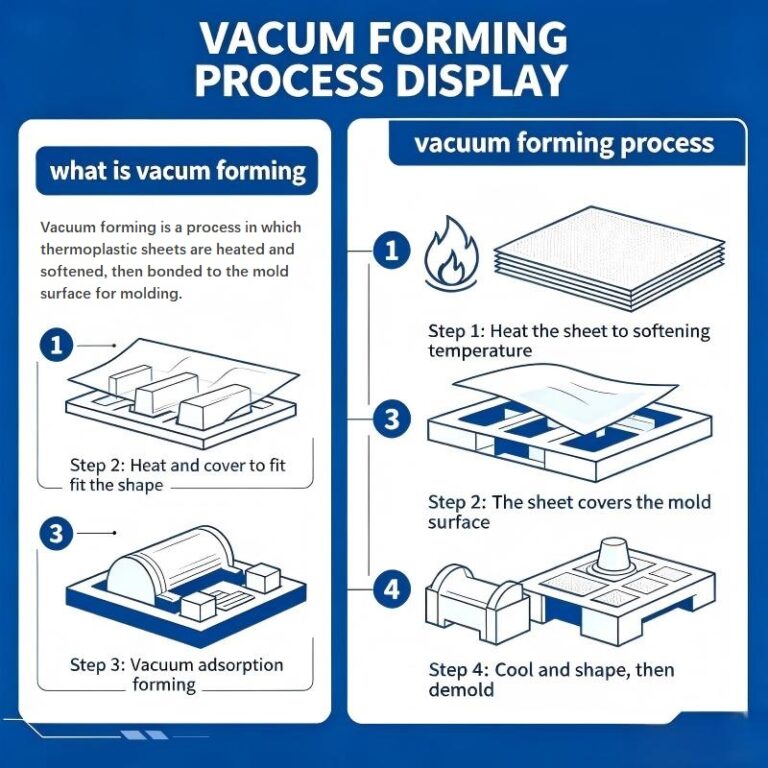
Thermoforming plays a different role. It is often a better fit when the part is larger, the tooling budget is tighter, or the project needs to move faster. Instead of forcing molten plastic into a highly complex closed mold, thermoforming shapes heated sheet material over a tool. That simpler setup is a big reason it becomes attractive as parts get bigger.
The larger the part, the more the process choice matters. A size that looks manageable in a quote can turn into a very different story once tooling, machine tonnage, and production realities are added in.
Part size affects much more than material usage. It changes the entire shape of the project.
A large part usually needs a larger mold, a larger machine, more careful cooling, more engineering attention, and more room for things to go wrong. That does not mean injection molding is the wrong answer. It just means the economics change fast.
Thermoforming, on the other hand, tends to stay more flexible as size increases. That flexibility is often the reason engineers and buyers start leaning in that direction once the part gets beyond a certain scale.
Injection molds are expensive because they have to do a lot. They need to hold tight tolerances, survive high pressure, cool properly, and produce the same result over and over again.
When the part gets bigger, the mold usually gets more expensive too. More steel. More machining. More cooling design. More time spent making sure the tool will run properly and consistently.
That is one of the main reasons large injection molded parts can become hard to justify unless the production volume is high enough to support the investment.
Thermoforming tooling is usually simpler. That simplicity does not make it less useful. In many large-part projects, it makes the whole program more practical.
Part size also affects the equipment that has to run the job.
Injection molding requires enough clamping force to keep the mold closed under pressure. As the projected area grows, the machine requirement grows with it. That can push the job into a larger press category, which often means higher operating cost and fewer available machine options.
That is not just a technical issue. It affects scheduling, production flexibility, and cost per part.
Thermoforming usually avoids that kind of pressure-heavy setup. It can handle large sheet sizes without demanding the same level of machine investment. For many manufacturers, that is a very real advantage.
The bigger the part, the more difficult it becomes to manage how molten plastic flows inside an injection mold.
Long flow paths, uneven cooling, and thick-to-thin transitions can lead to warpage, sink marks, weld lines, or cosmetic problems that are hard to fix later. Some of those issues are small. Some are not. In the wrong part, they can affect fit, finish, and performance.
Thermoforming does not remove all design challenges, but it avoids many of the flow-related problems that come with forcing molten resin through a complex cavity. That is one reason it often makes more sense for large, broad-surface parts.
Large injection molds usually take longer to design and build. That is not surprising. Bigger tooling means more complexity, and more complexity usually means more time.
For a company trying to launch a product, that can be a serious issue. A few extra weeks can be manageable. A few extra months can affect sales plans, customer commitments, and cash flow.
Thermoforming often has a shorter path from design to production. The tooling is typically simpler, changes are easier to manage, and the project can move with less friction. When speed matters, that difference counts.
This is one of the most overlooked parts of the decision.
In real projects, designs change. A wall gets thickened. A feature gets moved. A customer asks for a new detail. A new assembly requirement shows up late in the process.
With injection molding, those changes can become expensive once the mold has been built. If the part is large, that risk is even more serious because the mold itself is usually a major investment.
Thermoforming is generally more forgiving. That makes it a better fit for projects where the design is still evolving or where the product may need updates after launch.
A lot of manufacturing comparisons focus only on unit price. That is too narrow.
The real decision is usually about total program cost. That includes tooling, machine time, lead time, risk, redesign potential, and how much flexibility the company wants to keep after launch.
Sometimes the cheapest part on paper is the most expensive part to develop. That happens more often than people think.
For that reason, many teams evaluate not just the process, but the life of the project:
Will the design stay stable enough to justify expensive tooling?
Will the part size create pressure on machine availability?
Will future changes be likely?
Will the product benefit from faster turnaround and lower tooling risk?
Those questions often tell the real story.
Injection molding is still the right choice for many parts.
It is especially strong when the component is relatively small, the tolerances are tight, and the production volume is high enough to spread tooling cost across many units. In those situations, injection molding can deliver excellent consistency and very competitive unit pricing.
It is also a strong choice when the design is mature and unlikely to change much.
Thermoforming often becomes the better option when the part is large, the tooling budget is limited, or the project needs more flexibility.
It is commonly used for: large enclosures ,equipment covers ,panels ,housings ,appliance parts ,custom OEM plastic components
For these kinds of parts, thermoforming can reduce up-front cost, shorten development time, and make revisions easier to manage.
That is why part size matters so much. Once the part gets bigger, thermoforming often starts to look less like an alternative and more like the smarter fit.
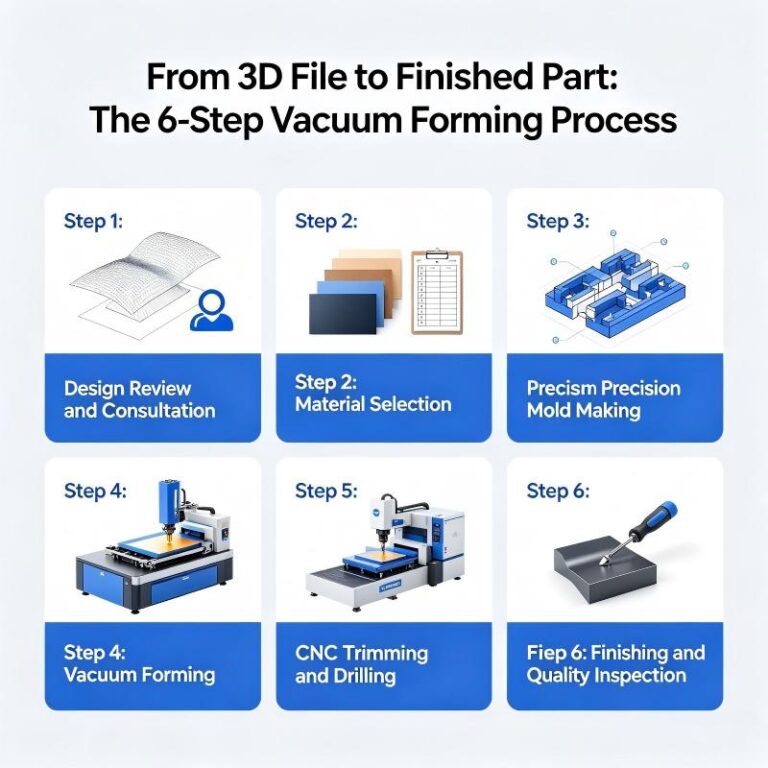
The best process choice usually comes from a real design review, not a quick quote.
A solid evaluation should look at part size, geometry, wall thickness, draft, surface finish, structural needs, production volume, and how likely the design is to change later. Those details can change the answer completely.
A part that looks simple on a drawing can be expensive to mold one way and very practical to make another way. That is why early technical review saves time and frustration later.
If you are working on a custom plastic part and are unsure which process is the better fit, the safest move is to review the part early.
The right manufacturing decision at the beginning can prevent expensive rework, reduce tooling risk, and make the launch much smoother.
Quality systems matter in any production project, especially when the part is large and the process choice has a big impact on cost and delivery.
ISO 9001:2015 certification shows a commitment to consistency, process control, and continuous improvement. For customers, that usually means greater confidence in the manufacturing process and the final result.
A good partner should bring more than machinery. It should bring judgment, engineering support, and the ability to match the right process to the right part.
Part size is not a minor detail in the injection molding vs. thermoforming decision. It changes the tooling strategy, the machine requirements, the timeline, the risk profile, and the long-term economics of the project.
Injection molding is often excellent for smaller parts and high-volume production. Thermoforming often becomes the more practical choice as parts get larger, especially when speed, flexibility, and lower tooling investment matter.
The best decision is rarely the one that looks cheapest at first glance. It is the one that fits the part, the program, and the business behind it.
If you need, I can make this sound even more like a real manufacturer wrote it, with a less “marketing” tone and a more technical, field-tested voice.

TKP Plastic is China's leading provider of vacuum forming solutions. We are defined by our commitment to innovation, uncompromising quality, and total customer satisfaction. Our expertise enables us to deliver projects that excel in cost-effectiveness, intricate design, and sustainable manufacturing. Partner with TKP to bring your vision to life with precision and reliability.